
Chuck Berry & Muddy Waters Home Updates
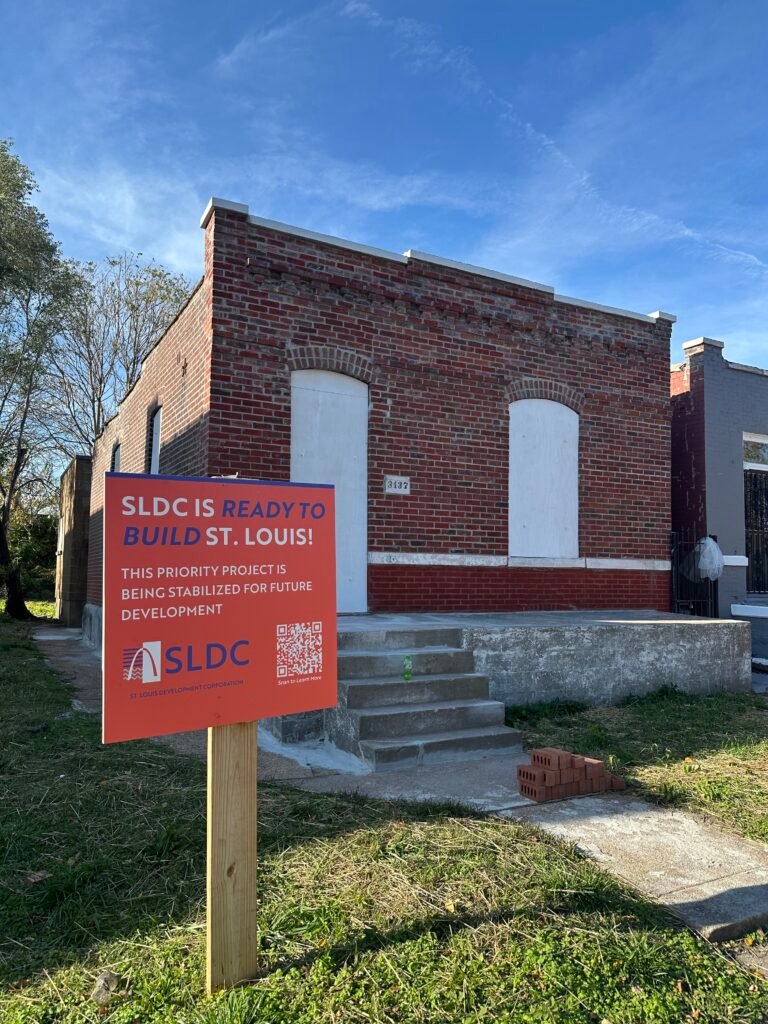
Chuck Berry digs, Oct. 2025. (D. Hoekstra photo)
A few months ago, I drove by the empty Chuck Berry House on the near north side of St. Louis. The modest red brick home is where Berry wrote hits like “Roll Over Beethoven” in 1956 and “Johnny B. Goode” in 1958. The Berry house is at 3137 Whittier Street in the economically challenged Greater Ville neighborhood.
The Berry house was added to the National Register of Historic Places in 2008, a rarity since Berry was still alive. Berry and his wife bought the three-room house in 1950 in what then was a middle-class Black neighborhood that included comedian Dick Gregory, boxer Sonny Liston, and dancer-singer Josephine Baker. The house was built in 1910.
Berry lived on Whitter Street until 1958, when he and his family relocated to a larger house in St. Louis. He maintained ownership of the house until 2010, when it was placed into the city’s Land Clearance for Redevelopment Authority (LRA) as owner of last resort. The Berry house has been vacant for nearly 20 years.
Since Berry’s death in 2017 at the age of 90, St. Louis has attempted to find assistance to revive the home. During my afternoon visit, the house was boarded up, and no one was around.
The City of St. Louis released a structural condition survey in November 2023, which revealed several images of the home in its deteriorated state. According to a Feb. 2024 report by St. Louis Realtors, the home had retained its original hardwood flooring, plaster doors, and fixtures.
A carpenter who used to help his father, Berry built a studio in the basement. As his father’s sideman, he saved enough money to buy his first new car, a cherry-red 1955 Ford Esquire station wagon. In his excellent 1987 autobiography, Berry wrote, “Each time I nailed a nail or sawed a board, I was putting part of a song together.”
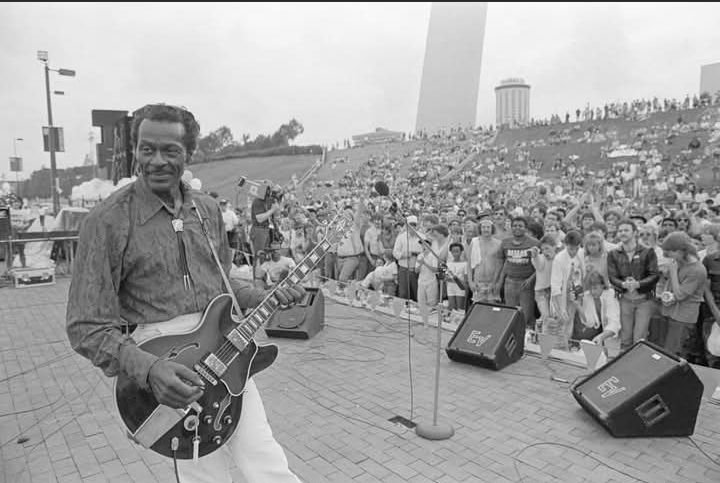
Chuck Berry in St. Louis arch concert circa 1986.
The house stabilization is complete, according to Shelton Anderson, LRA director and Vice-President of real estate for the St. Louis Development Corporation. Floors have been redone and tuckpointing has been completed. The corporation received American Rescue Plan Funding to proactively stabilize the Berry house.
“We don’t have any specifics on how the house will be used until we get development proposals, but we’re looking to get it into a full development plan in the next couple of months and hope to get it underway,” Anderson told me last week. “It is ready for full-out rehab for whatever the future use will be. The family has representation seeking to secure funding for a collaborative approach and cultural arts development around the Chuck Berry home. We’ve engaged with Chuck Berry, Jr.” His mother Themetta died in 2024. His parents were married for 68 years.
One vision is carried by a group called 4theVille that would employ the house as the centerpiece for a neighborhood destination. It is not that now. There is not even a marker denoting the house. Aaron Williams is Co-Founder and President of 4heVille and a planning commissioner for the City of St. Louis. He grew up in the historic 18th and Vine jazz mecca of Kansas City, Mo., and came to Washington University in St. Louis as an Ervin Scholar, where in 2008 he received a Bachelor’s degree in Architecture.
Anderson said, “Aaron made broad community recommendations in terms of securing a legacy that includes transforming as many homes as possible for the use of entertainers and to create a cultural arts boulevard. As the land bank we look forward to any offer presented by the family or the ownership in this regard. We believe it is an excellent way to preserve the history of the community.”
4theVille’s concepts include public art, supporting Black-owned businesses in the community, and promoting tourism.
Anderson added, “As far as the home itself, we hope this can happen in the next year or two at the worst. Because when stabilization money is put into these properties, we want to see it get occupied within a year’s time, even if there are further things with streetscape, parkscape, banners and whatever may occur.”
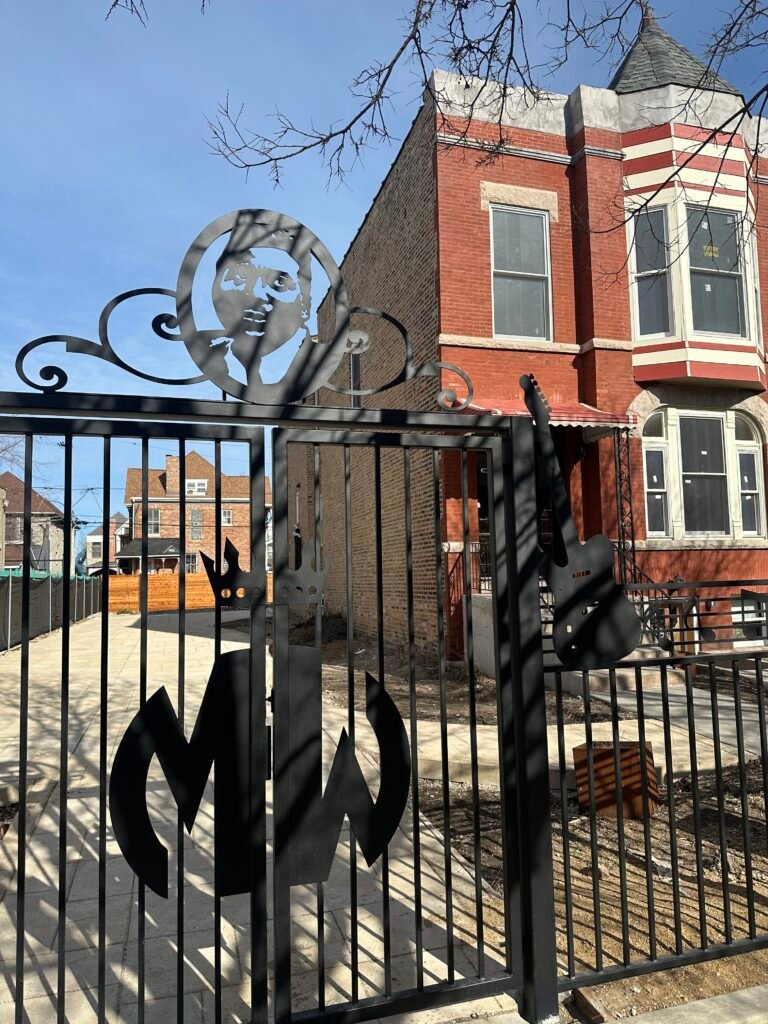
Muddy Waters House, March 1, 2026 (D. Hoekstra photo)
Transitioning from St. Louis to another significant musical landmark, I next drove by the Muddy Waters House, 4339 S. Lake Park Ave in Chicago. The house was added to the National Register of Historic Places in 2023.
Muddy visited Berry’s house in 1955 after he appeared at the Cosmopolitan Club in East St. Louis. Muddy helped introduce Chuck to Chess Records. Muddy and his wife Geneva purchased the Chicago home in 1954. Mike Bloomfield once sat in the living room and Otis Spann played piano in the basement. One of Muddy’s kids mentioned being bumped out of his bed for a visitor. That was Chuck Berry.
Muddy remained on Lake Park Avenue until 1973, when he relocated to the west suburb of Westmont. He died of heart failure in 1983.
Now the Muddy Waters MOJO Museum, the house project continues to move forward. The Commission on Chicago Landmarks granted landmark status in 2021, protecting it from demolition and any Mar-a-Lago inspired exterior facelifts.
Muddy’s great-granddaughter, Chandra Cooper is President and Executive Director of the MOJO museum. She has been working on the property restoration at least since 2013 when I was writing about the house for the Chicago Sun-Times.
Barry Dolins has advised the group and is an Emeritus Board Member. Dolins was Deputy Director of the Mayor’s Office of Special Events until his retirement after a 27-year career in 2010. Dolins, 77, is a noted Chicago blues historian.
“Chandra has done an amount of work you couldn’t imagine,” he said in a late January phone conversation. “It is a residential area. The south side has a collection of significant home museums, going back to the South Side Community Arts Center, which was in a home (founded in 1940). It speaks to the whole concept of Black Metropolis or Bronzeville.”
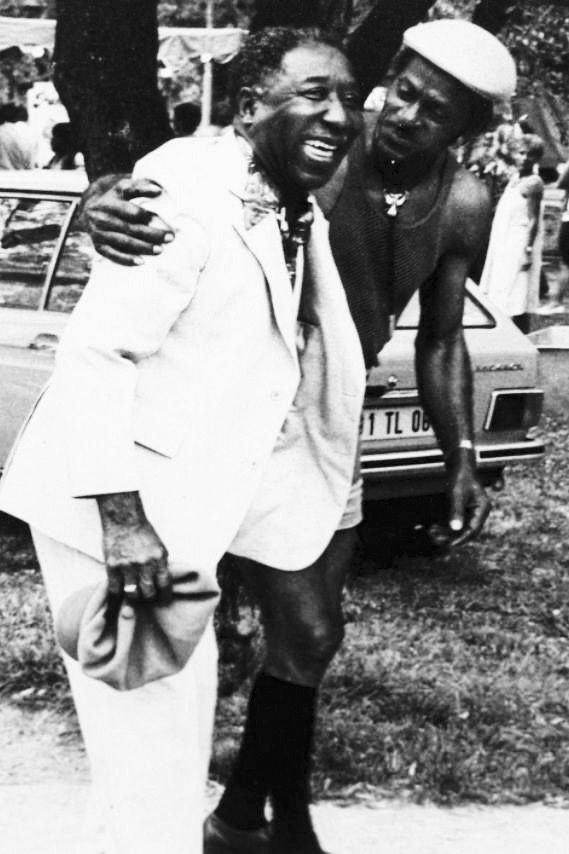
Muddy (left) and Chuck.
Dolins cited Rep. Bobby Rush’s 2021 bill that designated Bronzeville as a National Heritage Area. Congress designated the Bronzeville-Black Metropolis National Heritage Area in 2023. Boundaries stretch from the South Loop to Woodlawn, 18th Street to the north, 71st street to the south, Lake Michigan to the east, Bronzeville and Canal Street to the west. The commission works with local entrepreneurs on urban development. The area incorporates the MOJO Museum, Quinn Chapel (2401 S. Wabash, the first independent Black denomination in the United States) and the Ida B. Wells monument (Richard Hunt sculpture, 3729 S. Langley) and more.
“So look at Blues Heaven (Chess Records, 2120 S. Michigan) down to Muddy’s house, unfortunately nothing is going on at (historic) 47th Street,” Dolins said. “I always saw this as not one museum but a neighborhood that you can drive through and visit these places. Before I worked for the city I’d rent the bullet nose bus air transport bus. I’d give people the whole south side tour where Tampa Red lived to the churches, stop for a barbecue and end up at the Checkerboard (gone at 423 E. 43rd St.)”
Shermann “Dilla” Thomas does this today with his Chicago Mahogany Tours.
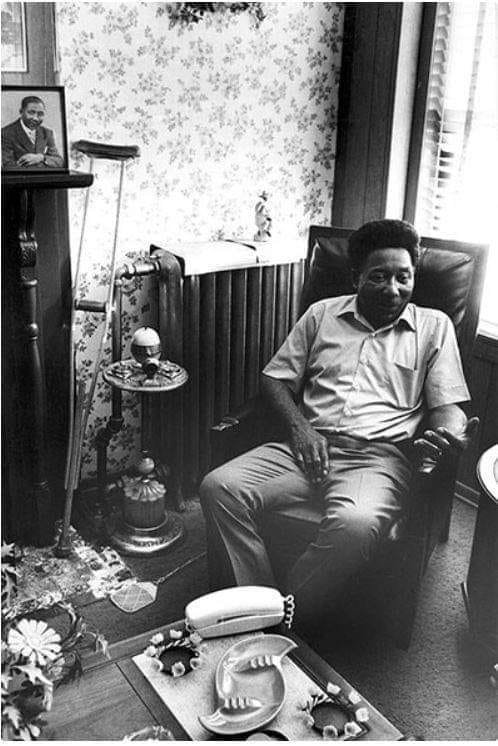
Muddy at home (Via MOJO Museum Facebook page.)
Dolins said, “Chandra is hoping there could be a community of a living kind of museum. It’s not going to be Wrigley Field. First all we don’t have Ricketts money. Second, you can’t displace people. (Drummer) Kenny “Beedy Eyes” Smith’s mother still live three houses away.” Family patriarch Willie “Big Eyes” Smith (1936-2011) played drums with Muddy.
“They’re all row houses there,” Dolins continued. “I go back as a historian. Jimmy Walker, the piano player, was one of my primary sources. He moved to Chicago (from Memphis) in 1905. He lived around State Street. If you went east of Michigan it was white. Where Muddy’s house is, that was a white neighborhood. Muddy was a pioneer that was able to take over that house. (Pianist) Erwin Helfer has the story how there used to be a People’s Music school in that house before Chess and Muddy got together and bought that house. That’s Kenwood. You’re not going to disrupt a neighborhood like that by commercializing it.”
Cooper wouldn’t say much when I contacted her. I heard the museum could be open this summer. She did not confirm that. She did say the museum is working with preservation and exhibit experts on their next steps. This includes Rita Organ, Exhibit Research and Design Consultant, who recently documented the historic African-American community in Madison, Ind. A new black iron fence embedded with Muddy’s portrait was installed late last year.
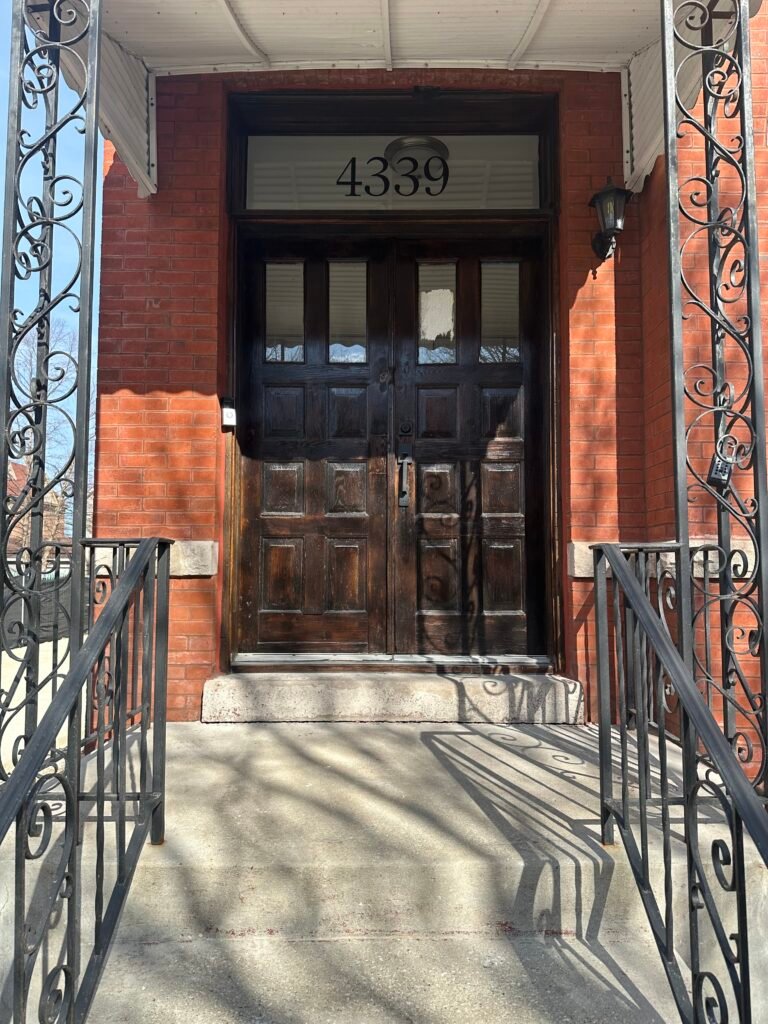
Many musical icons sat on these steps at the Muddy Waters House (D. Hoekstra photo)
In June 2023, the MOJO museum received a $1.1 million grant from the Mellon Foundation. In 2002, the Commission on Chicago Landmarks awarded $250,000 to the museum. Cooper also has been paying attention to the restoration of Nina Simone’s childhood home in Tryon, N.C. Three area contemporary artists stepped in to form Daydream Therapy, LLC.
One of the artists is Rashid Johnson who was a student at Columbia College in Chicago when he photographed unhoused Chicago men in his 1998-99 series “Seeing in the Dark.” Johnson grew up in Wicker Park. They purchased the Simone home for $95,000 and plan to open it to the public, according to a Nov. 2025 report in Smithsonian magazine.
Blues singer-journalist Deitra Farr is a MOJO board member. “Thank god for grants because we can’t depend on rock stars,” she said. “I wish I knew why more musicians haven’t supported the Muddy house. When you talk to them they say it is great but they haven’t come out with support. Involved involved? Me and Kenny Smith. We’re board members. Not that musicians have so much money but you just feel there’s no love coming from the blues community. I don’t think Chicago people care enough about the wonderful musicians that came through here. The Sam Cookes, Nat King Cole, Dinah Washington, Muddy and Wolf. When you go to a place like New Orleans they broadcast their culture and their musicians. They have statues. We feel unloved here.”
A Buddy Guy statue? Chicago’s lack of recognition for its music icons goes far beyond statues. I’ve spent a good portion of my 40-year Chicago media career harping on the case for a quality blues-soul facility in Chicago with a professional museum staff. I’ve advocated through articles, radio shows, and I even wrote a music exhibit for the Abraham Lincoln Presidential Library and Museum. I doubt I will see much transpire in my lifetime.
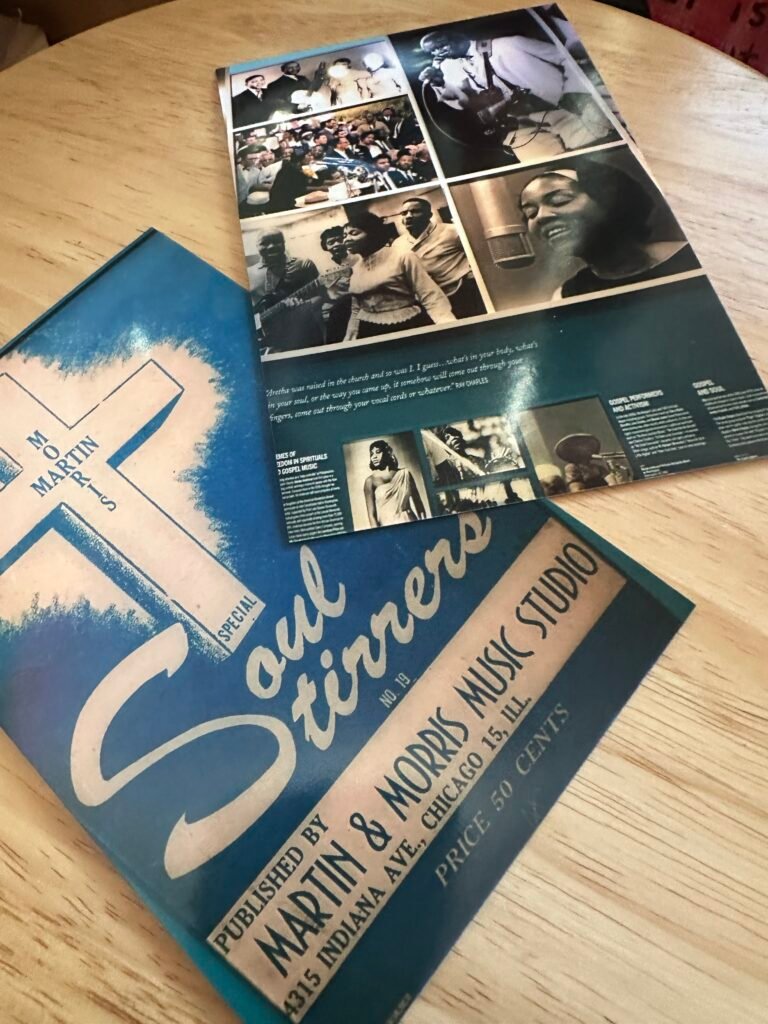
I enjoyed Chicago history at the National Museum of African American Music in Nashville, Tn.
But I can go to the National Museum of African American Music in Nashville and see a washboard owned by Bo Diddley, a piano from Chicago’s iconic Pilgrim Baptist Church used by Thomas Dorsey, a proclamation from Chicago mayor Harold Washington honoring the AACM and even a couple of audience photographs from Sun-Times Pulitzer Prize winner John H. White.
I’ve seen wall sized portraits of the Chicago Theatre and Sam Cooke and the Soul Stirrers at the National Blues Museum in St. Louis. I’ve heard Chicago music in their museum.
“This is a great blues community but everybody’s got so much self-interest that nobody lets them march together,” Dolins said. “If we all marched together, we would have a better scene. I have a dream that we should have a Blues Congress for the city where all these people would have representation. There’s the new Chicago Blues Revival, I’m dropping these thoughts on them.” This non-profit was founded in 2018. Board of Directors includes blues guitarist Toronzo Cannon and Jennifer Littleton.
“Diamond Dixon of the (Willie) Dixon clan is the executive director, but she has a full-time gig too.,” Dolins said. “They’ve done programs on the south and west sides but it could use a little uplifting and direction.” Diamond Dixon is Vice-President at JP Morgan Chase in Chicago.
Littleton has managed Blues Etc. and Blues on Halsted (1994-2000) and was involved with the rebirth of Lee’s Unleaded Blues, 7401 S. Chicago. She left Lee’s in 2024. She is shop manager at Delmark Records. Littleton is artistic director for Chicago Blues Revival. “Part of our mission is events, education and advocacy,” she said. “We’ve done nights out in the park with the Chicago Park District. We’ve worked with Urban Juncture to help put on shows during Open House Chicago. We support musicians whether it is legal counsel or medical help. We apply and work to get a lot of grants. We don’t have a physical office yet but we will at some point.”
Diamond Dixon is the granddaughter of Willie Dixon. Willie’s daughter Jacqueline Dixon is president and chief executive of the Blues Heaven Foundation at the historic Chess Records studio. “When I met Diamond she didn’t present herself as a Dixon for the first three months or so,” Littleton said. “Then she said, ‘By the way, Marie (Willie’s wife) is my grandmother. She’s a lawyer.” So does Chicago Blues Revival work with Blues Heaven? Seems easy to do.
“We’re doing our own thing right now,” Littleton answered. “We haven’t found them super close, but that’s not necessarily our focus. We would certainly collaborate with them if it came up.”
Dolins explained, “If you want to be an advocate in having people that have power, whether it is a venture capitalist or the city listen to you, you have to be like a Jazz Institute. A constituency. I wish everyone all the best and I can give them free advice. But hey, I’m retired and I don’t have the energy to do all this. I’m off to the Caribbean in the winter.”
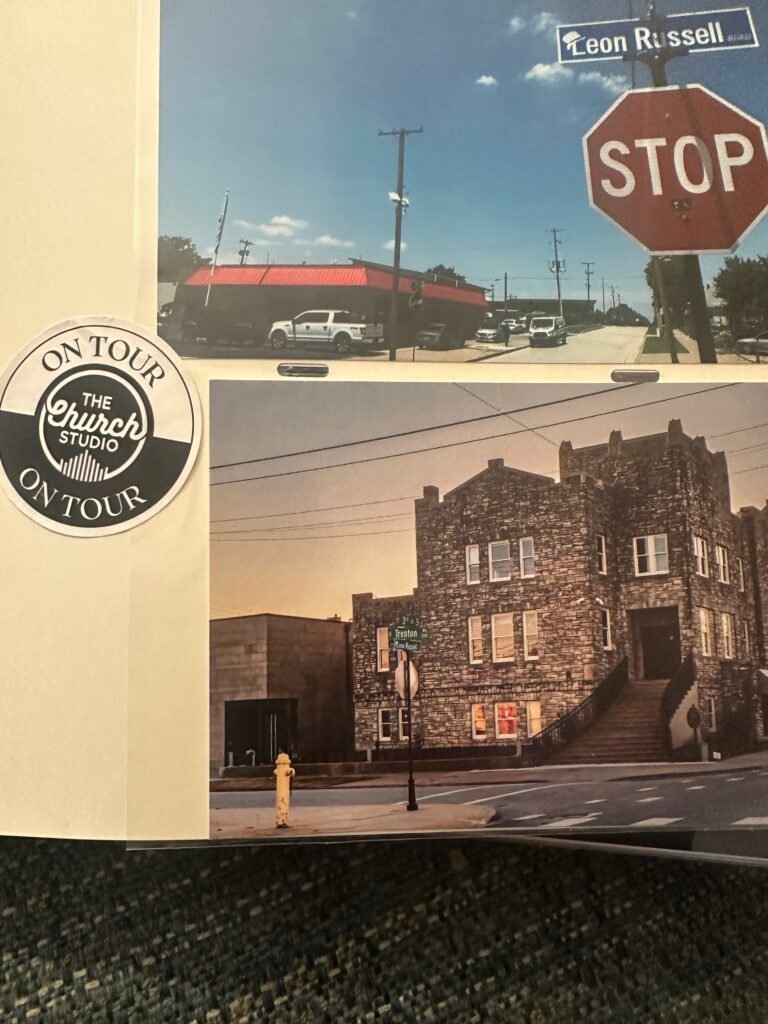
The Church Studio museum (From my 2022 Dylan-Leon Russell Tulsa scrapbook!)
Maybe collaboration is easier to navigate in smaller cities such as St. Louis and Tulsa, Ok. Tulsa has done a brilliant job in reimaging the neighborhood around Leon Russell’s Church Studio. When I visited Tulsa in the summer of 2022 the refurbished studio had inspired new businesses in the neighborhood such as Studio Records (with lots of Tulsa vinyl), a coffee shop, and at the time of my trip there was a small Cuban bistro. The vibe seamlessly meshed history with the future. The area has recently been named “Studio Row,” not unlike Chicago’s forgotten “Record Row.”
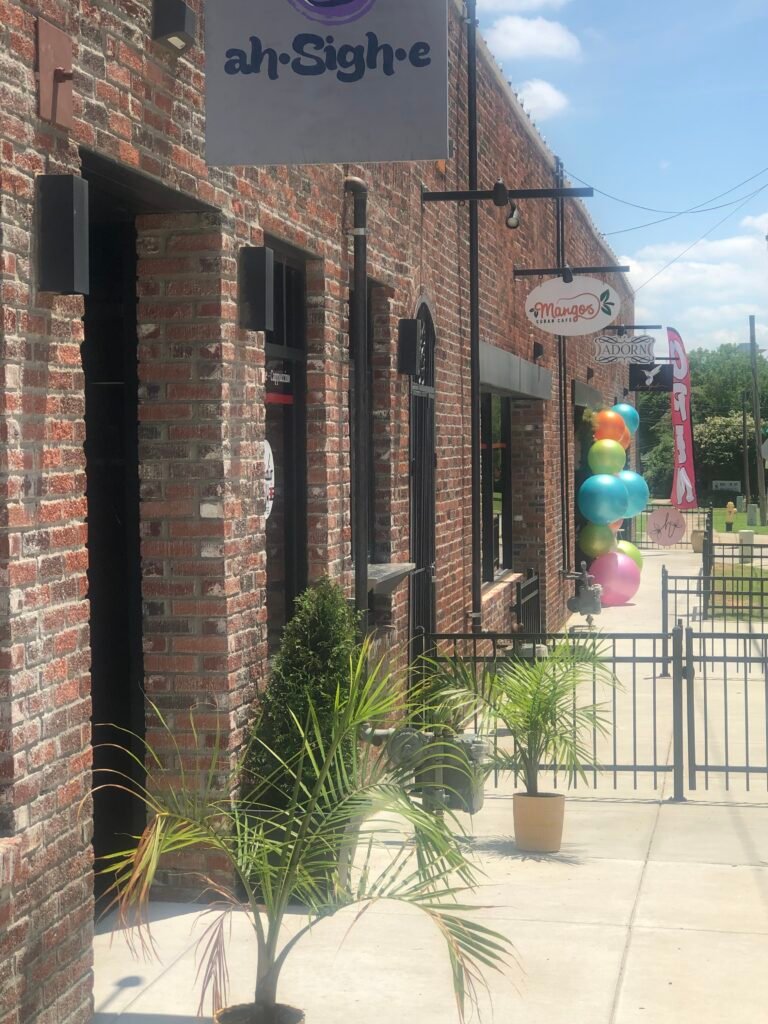
Tulsa’s new Studio Row from 2022 visit.
Church Studio’s CEO Teresa Knox is purchasing buildings in the neighborhood, east of downtown Tulsa. This effort is privately funded by Knox. She has invested a reported $3.5 million to develop nine buildings in the neighborhood.
A Tulsa native, Knox is the founder and former CEO of Community Care College, Clary Sage College and Oklahoma Technical College. In 2017 the Tulsa World newspaper named her “Tulsan of the Year.” All these organizations should come together form a Roots Renaissance Commission.
Perhaps the MOJO museum will jump-start things in Chicago. A garden adjacent to the house has hosted outdoor concerts and yoga sessions and there is talk that a third-floor apartment could be a space for artist residencies. Somewhere, between Chicago and St. Louis, the mojo may be working.


Excellent piece!
Thanks, Jeff!
Excellent article. For what it’s worth, this is my own take on the challenges Chicago has faced in honoring its blues (and Black) music legacy. I have been an observer on the fringes for many years and have been engaged in these discussions long before I hosted the Blues symposia at Dominican University that ran from 2008 through 2016. I have to say that your overview is far more objective and polite than I would have been able to write.
As I see it, the main issues impeding the recognition, establishment, and promotion of Chicago’s musical legacy is the lack of intentional cooperation and coordination among the existing entities and the city of Chicago, and the absence of substantial and continuing financial backing from individual donors, private foundations, and corporate sponsors. In this economic climate, reliance on grant funding is no longer a sound operating policy, and probably never was. And we all know by now not to expect Mick, Keith, Eric, et. al. to ante up.
What diverse initiatives like the Blues Revival, the Mojo Museum, and Blues Heaven have in common is that they are all largely dependent on grants and have little capacity for significant fundraising. While they may have committed board members, they have not attracted sufficient corporate or private philanthropic support, nor have they garnered the kind of commitment from the city for sustained development. The many failed attempts to establish a national blues museum in Chicago have taught us that. Despite the commendable efforts of people like Deitra Farr, Jeff Penzino, Diamond Dixon, and Jennifer Littleton, they and their respective board members do not have the public profiles, specialized skill sets, and necessary connections to attract long-term, maintainable financial viability. Barry Dolins, whose comments align with my own assessment of the current reality, has the broad knowledge and administrative skills to develop a workable vision, but, as he points out, he is now well into his retirement. Chandra Cooper and Jacqueline Dixon are not based in Chicago, and from what I have seen, the Mojo Museum and Blues Heaven have never been receptive to collaborative efforts with outsiders.
I like Barry’s idea of a Blues Congress. I have for several years advocated for a cultural/entertainment district spanning the old Record Row to bring much-needed tourist dollars into the city and provide employment for residents. I agree with you that it is probably easier to accomplish these kinds of initiatives in smaller cities. Memphis, for example, while smaller than Chicago but even more economically challenged, has been able to establish itself as an international tourist destination for fans of black music, a market that is quite distinct from the draw of Graceland. The Stax Museum, the Stax music academy, and a charter school, through city, corporate, foundation, and private donor partnerships, not only attract visitors but also benefit Memphis residents.
Again, a great piece. You prompted me to emerge from my safe enclave in retirement to share my thoughts.
My best,
Janice Monti
Thanks, Janice.
Very well articulated, and yeah, I guess I was nuanced. I certainly agree with resistance to outside help. I remember writing about Sun Records offering to come in to help Blues Heaven (to make it move forward to a real museum), and they were rebuffed. Also, agree on a local presence. I already went long, wanted to talk more about the Leon Russell neighborhood in Tulsa. Private funding but check it out. Dave