
Pete Rodriguez Collected the Truth of his Journey
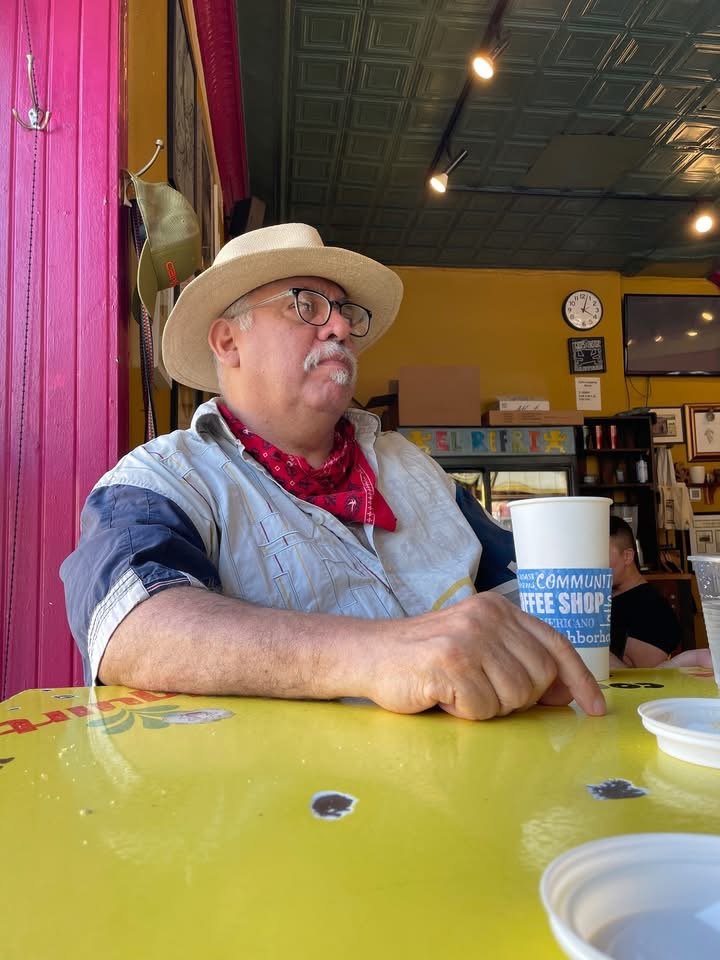
Pete Rodriguez (Photo by David Aguirre)
During the early 2000s, Pete Rodriguez lived large in a former photography studio above the Cafe Jumping Bean, 1439 W. 18th St. in the heart of Pilsen. The three-story building with an aqua dome top was constructed in 1907.
Pete used the 18-foot skylight as a backdrop to photograph neighbors and Chicago cultural icons, including the late artist Carlos Cortez. Rodriguez was also a former Marine, house painter, contrarian, and colorful activist.
Many called him the “Mayor of 18th Street.”
Rodriguez died of a diabetic coma on July 6 in his upstairs apartment a block south of 18th Street. He was 68. He traveled but never left home. He was in the air like a hungry cardinal.
I attended a couple of parties at Pete’s place in the early 2000s. I became friends with his compatriot Ricardo “Ricky” Moreno, who lived in an adjacent apartment above the Bean. Ricky fell asleep on my shoulder after Sammy Sosa hit a first-inning home run on a hot day in September 2003 to clinch the division title at Wrigley Field. Someone to lean on. That’s what friends are for. But that’s another story. There are always more stories with Pete and Ricky.
You will hear many of them at 6 p.m. Aug 7 at Citlalin Gallery Theater, 2005 S. Blue Island, in a memorial send-off for Pete. Poet-writer Gregorio Gomez will emcee the event. The Miles Minor Blues Band will perform along with The Sounds of Rick Sherry and Mystic Music from DJ Eric.
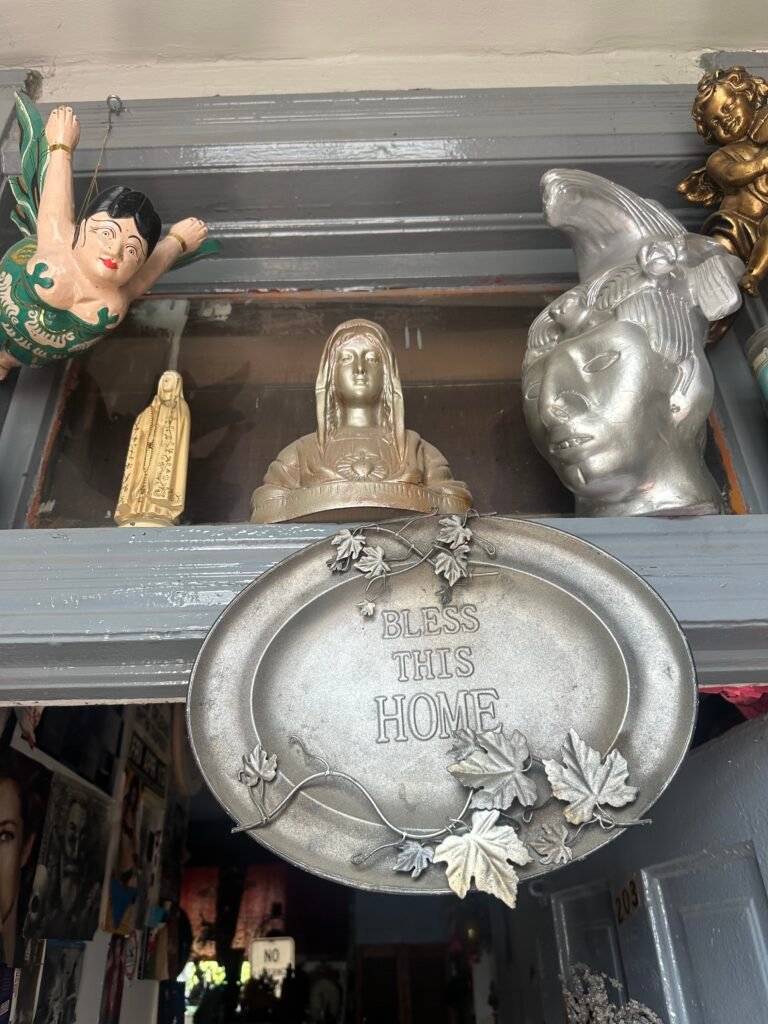
Pete’s Place 7/23/26 (Hoekstra photos)
The Chicago-based dance group Se Llama Xochitl-Queztal (“Precious Flower”) will do dances for the dead in a procession from Pete’s place at 1500 W. 19th St. to the gallery. A funeral mass for Pete will be held at 11 a.m. Wednesday at St. Pius Church, 1901 S. Ashland Ave, also a block from where he lived. A memorial visitation begins at 9 a.m. Wednesday.
Pete had a keen eye for Chicago art and history. His Bean pad included work from Chicago sculptor Roman Villarreal, cartoons by Dean Ewing, the 1990s-era Chicago Reader artist (father of poet Eve L. Ewing) and a stunning Robert Valadez portrait of blues harpist Sugar Blue.
Rodriguez began gathering artifacts when he moved into the loft space in 1984. He left with everything in 2005 when he moved into a circa 1889 building on 19th St. Rodriguez rebuilt much of his museum in the apartment where he died. It was a nest of many stripes.
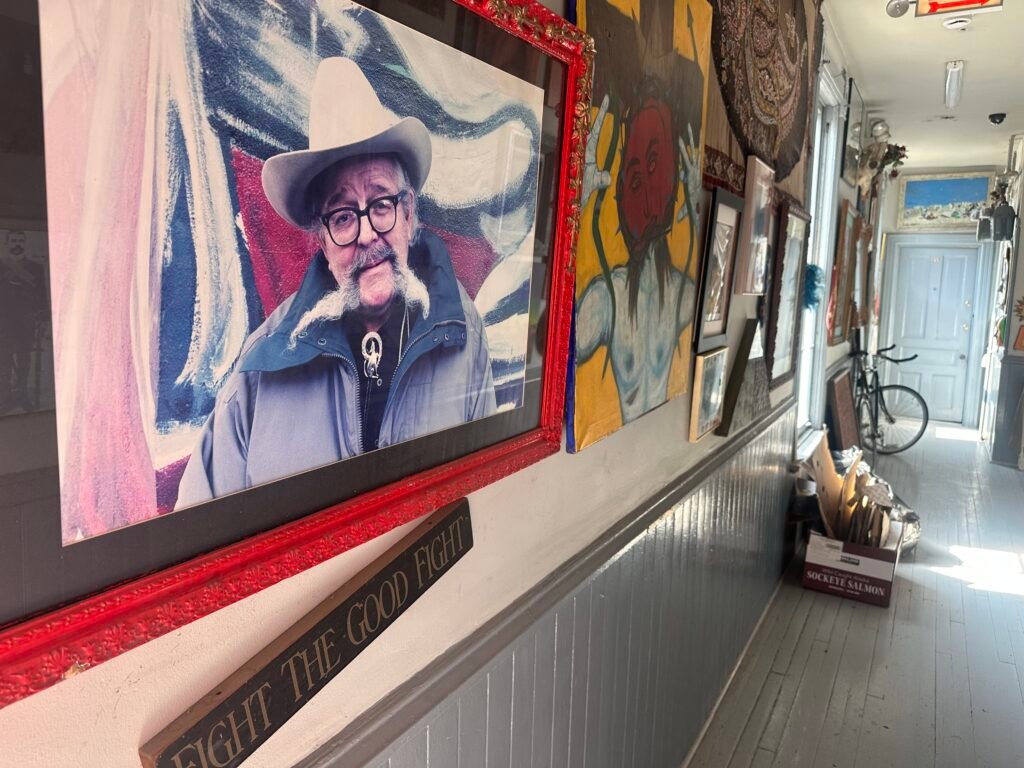
The great Carlos Cortez at Pete’s Place
Last week Moreno and Pete’s brother Artie invited me to the apartment-museum, where they were going through physical things from an unchained life. In a long hallway, one of Pete’s color portraits of Carlos Cortez was accented by a sign that read “Fight The Good Fight.” Cortez (1923-2005) was a prolific graphic artist and proud member of the Industrial Workers of the World (IWW) since the end of World War II.
In a small, collaged bedroom, there was a heavily tattooed mannequin. The Beatles “Ticket to Ride” played through a small speaker. Moreno unearthed a noir photograph of the Jumping Bean next to a ‘45 of Green Beret SSgt Barry Sadler’s “The “A Team”/”An Empty Glass”. Moreno has been cleaning out the space every other day since Pete died.
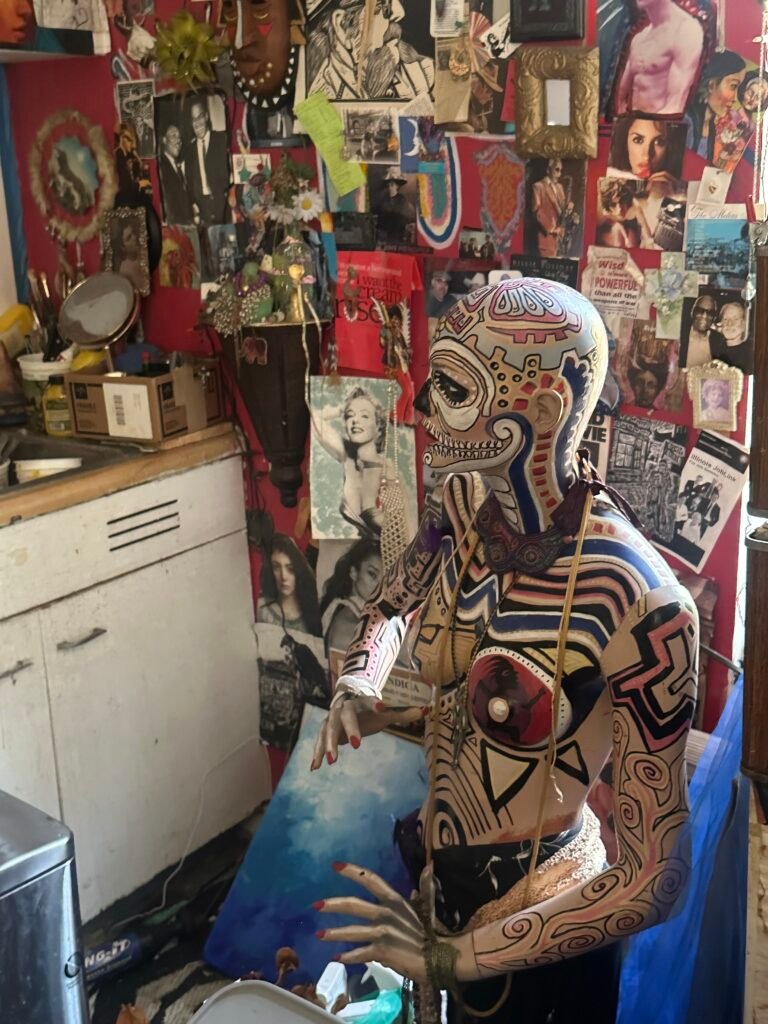
Pete’s Place 7/23/26
“Where do you start?,” he asked as he sat in a chair holding a copy of “American Illustration Annual: Sweet 16.” Moreno wore clear cleaning gloves. Beads of sweat trickled down his forehead. He continued, “Photographs, books, artwork, a book signed by Ken Burns, Playboy magazines from 1972.”
How does one define beauty?
In 2004, Chicago artist, public school teacher and filmmaker Mark Nelson made this fine 11-minute documentary “Pete’s House.” Nelson lives in Pilsen, where he operates Gringolandia Studio. His other documentary topics include national parks in Arizona and South Dakota, where he worked as a National Park Service ranger.
“I saw between 300 and 400 items at Pete’s (Jumping Bean place) back then,” he said last week. “He collaged everything, but even more like a mosaic. Even in the bathroom. So he was mosaicking with all his drawings, photographs, paintings and clippings.”
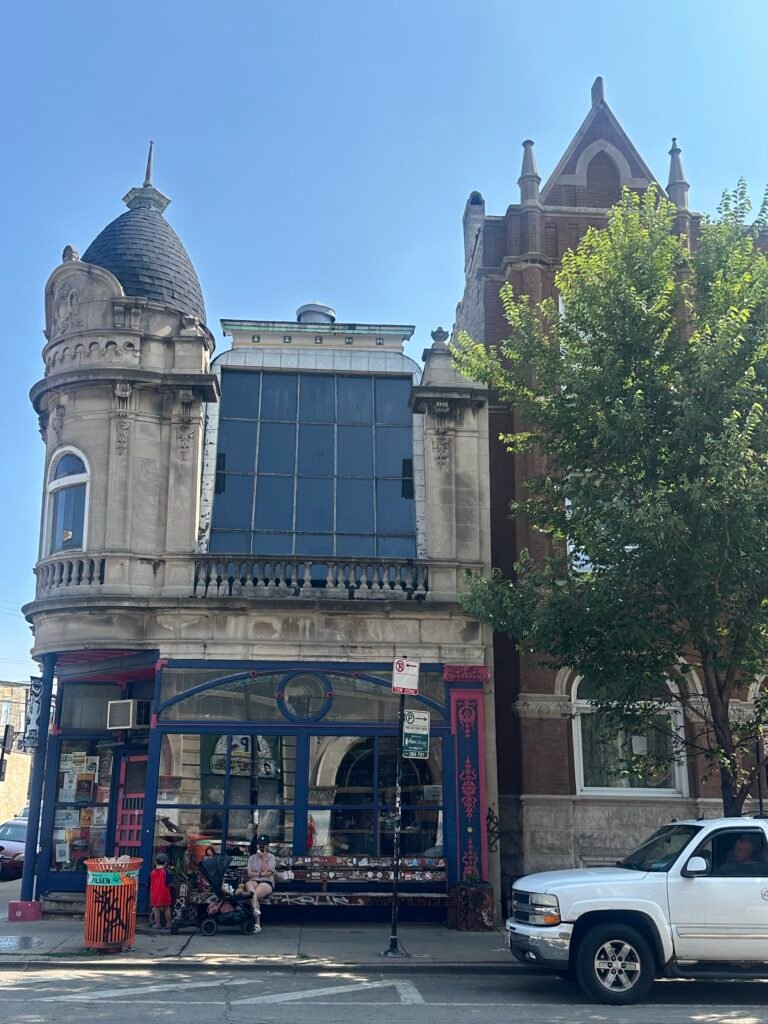
Pete’s upstairs Jumping Bean place in the heart of Pilsen 7/23/26
Pete was a serious collector of Maxwell Street artifacts. They created good memories. During a round table at the Citlalin gallery, Artie said, “Pete remembered all the players in all the stories. We’d go to Maxwell Street as kids. There was a basement store just east of Halsted. We called this guy ‘The Gymshoe Creeper.’ We’d buy Converse All-Stars. The guy literally had 250 different pairs of shoelaces so you could get a pair of black suede with black and white shoelaces and tie them all fancy. Then we would walk down the street and get a sandwich. All these blues artists would be playing in the street and my brother gravitated towards that.”
I wondered what motivated Pete.
Nelson cited the 2005 film “Everything is Illuminated” where a young Jewish-American curates random items to honor his family’s memories. “The guy finds this guy in a sunflower field in the Ukraine that has all these files on the dead from the Holocaust,” Nelson explained. “It’s that imagery. The guy was called ‘The Collector.’ Pete wasn’t preserving victims.
“But he was preserving the visual punctuation of his journey.”
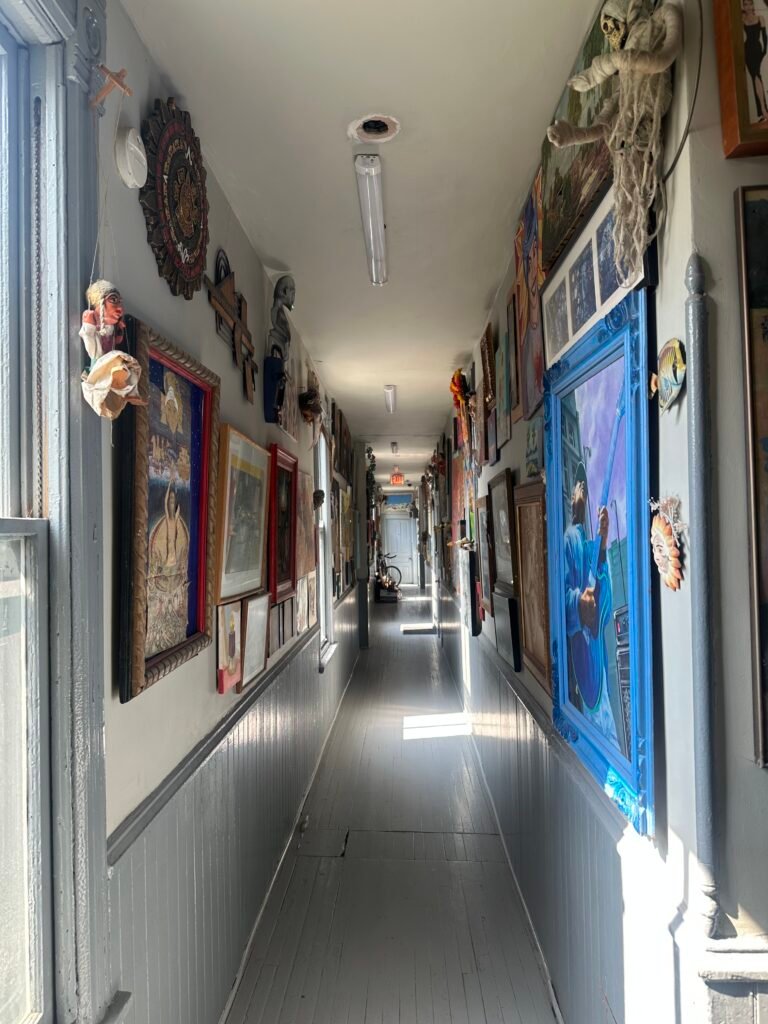
Pete’s Place 7/23/26
Nelson also does home mosaics but he deploys tiles. “Not paper because I’m paranoid about fires,” he said. “When I retired from teaching I started binge watching Dr. Who. I do digital media in my office. I thought it should look like the inside of a TARDIS (Time and Relative Dimension in Space.) So I redesigned my office to look like the inside of one of Dr. Who’s time machines.” Lots of stuff can feed the soul.
Pete’s time on this earth began on Feb. 13, 1958 when he was born in Pilsen. His mother Velia worked at Amphenol, the hearty union electronics house run by IBEW local 134 in Cicero. Artie, 66, joined local 134 and retired last spring after 38 years of service. While standing in his brother’s hallway he pulled out a set of keys punctuated by a shiny union logo keychain. Pride is an emblem of the Rodriguez family.
A color portrait of a beautiful 22-year-old Velia watched over his shoulder.
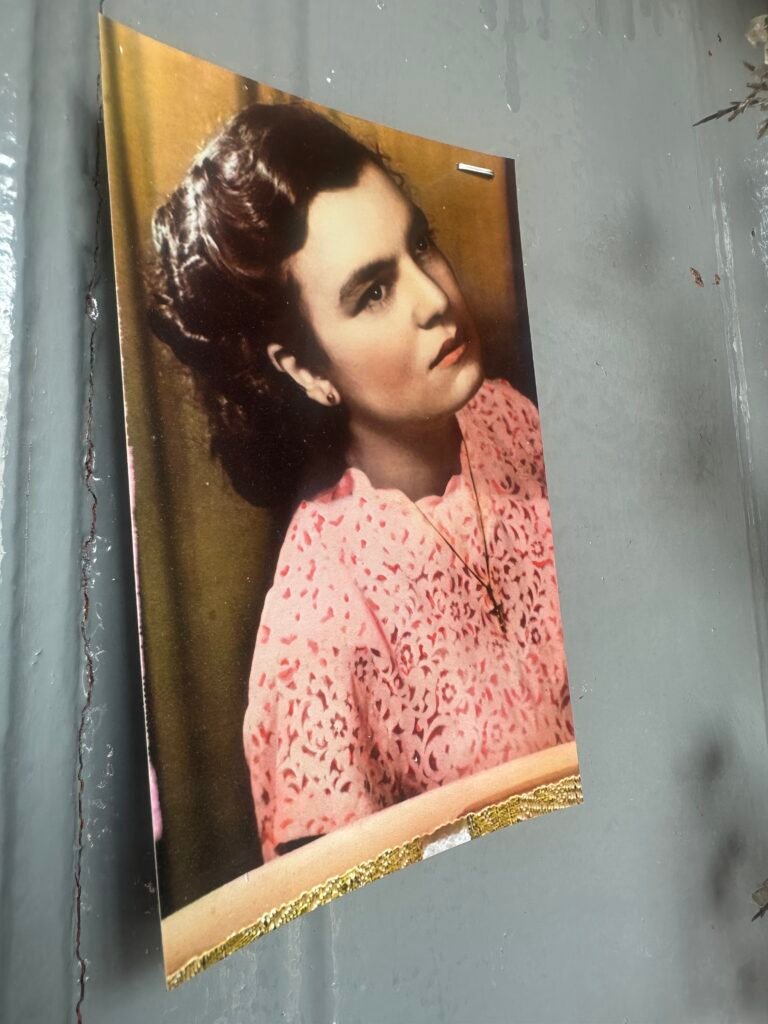
Pete’s mom 7/23/26
Pete’s father left the family when he was two years old. Pete attended De La Salle High School. “My mother had no money, so he mopped floors after school to help the family,” Artie said.
“All these guys made fun of him. It built character, and he handled it like a champ. ” he said. (Artie was a Gordon Tech wrestler and then attended Whitney Young where the future Michelle Obama was a classmate.)
Pete dropped out after his junior year to get married and join the Marines. In 1976, he was sent to Parris Island in South Carolina and served in Germany. He spent three years in the service. Artie said Pete was married for a few years. He had no children.
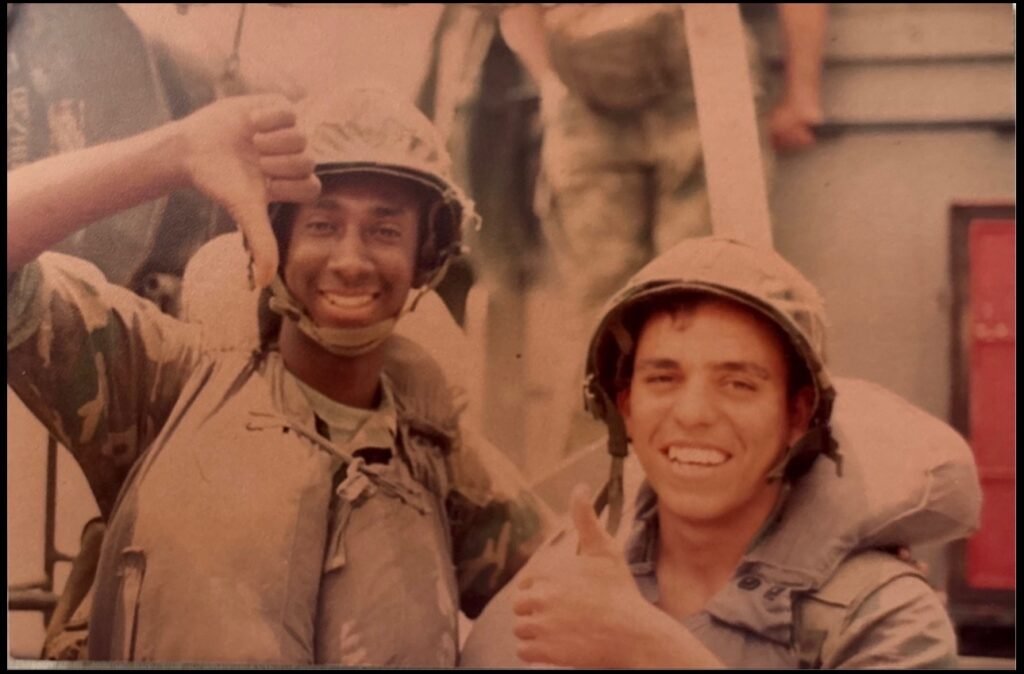
Pete Rodriguez (right) enjoying Europe. (Provided).
Later in life, Pete was a doorman at the 1320 S. Prairie condo building. Pete never owned a car. The CTA was his magic carpet ride through the city.
Pete’s family is real Chicago. His older brother Angelo is a retired Chicago police officer. His sister Maria Rosario Rodriguez died of cancer in 2012. She spent 35 years as a CPS elementary school teacher including 12 years as principal at Reilly Elementary School, 3650 W. School St. Artie and his wife Suzette have three children. They live in Indian Head Park. Elyse is a Chicago police officer, Mike works in baggage claims for Southwest Airlines and Gabriel, the youngest, is stationed in Germany as a member of the Air Force.
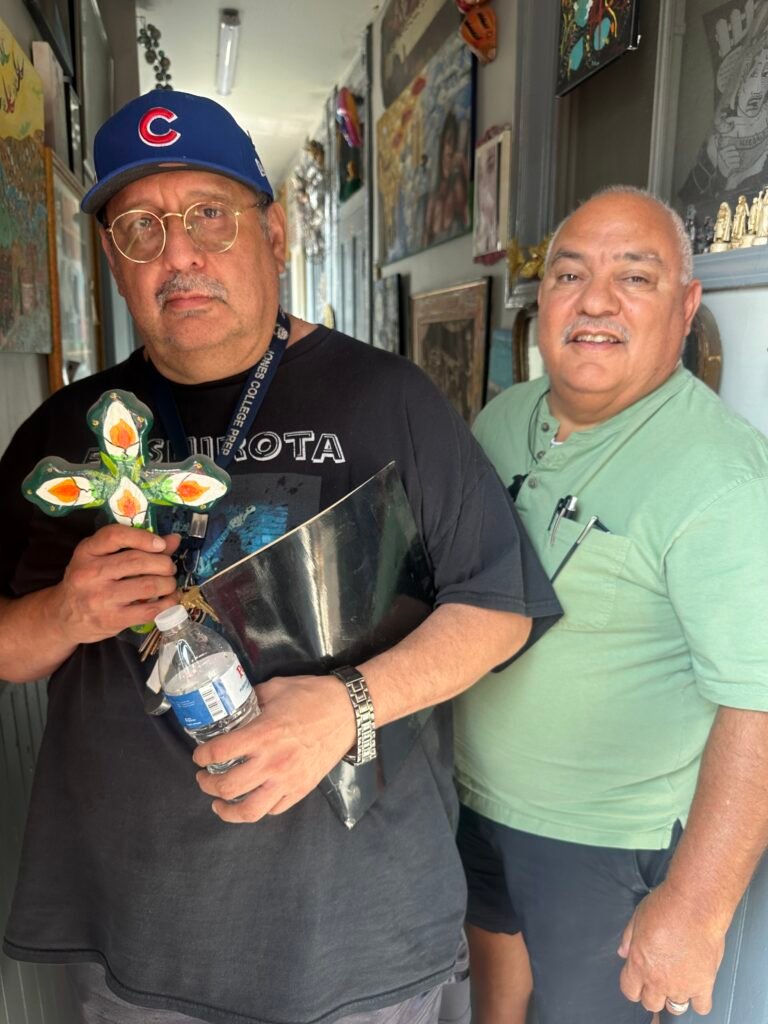
Rick Moreno (L) and Artie Rodriguez. (Hoekstra photo)
The 60-year-old Moreno is another Pilsen community figurehead. He was Pete’s best friend. Moreno and his wife Susy still host annual Pilsen hat parties that became an extension of the events he hosted with Pete above the Bean.
Moreno is a teacher at Richard Edwards Elementary who previously worked as director at the El Hogar Del Nino (the Home of the Child) after school program. His father Rafael died of cancer in 1999. In January 2000 his mother Maria died after being hit by a van while crossing 18th Street, a block east of the Jumping Bean.
Pete and Ricky were a team of muscle and hustle. Pete weighed in at 5’8” and “a biscuit under 270 pounds,” according to Artie. Moreno admits to being a bit below 270 pounds. Pete tilted direct and rough. Ricky is a carousel of fun and optimism. “He wasn’t a little rough around the edges,” Moreno said. “He graduated with honors in ball busting. We had a yin-yang thing. He ruined chess for me. He wouldn’t stop talking and insulting whoever played him. You just wanted to get the game over. Pete had no filter. He saw through bullshit. It didn’t matter if you were a regular Joe or director of a community program.”
Artist-muralist Valadez said of Pete, “Beneath that crusty exterior there was more hard crust.”
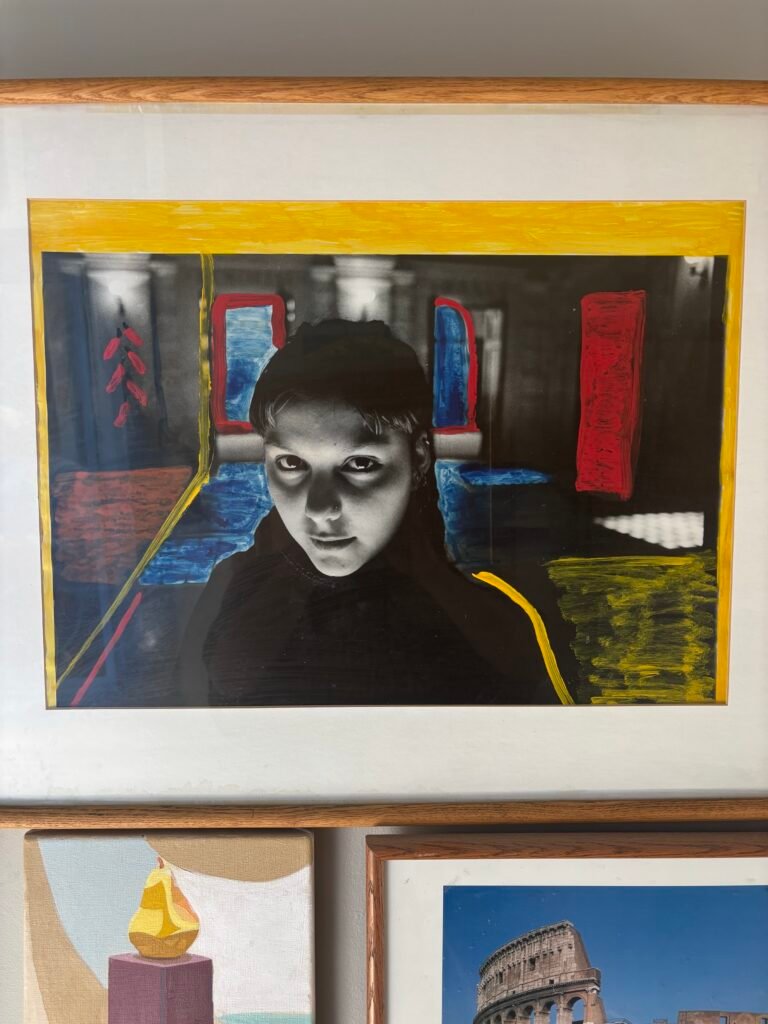
A portrait made by Pete was found in his place.
During the anthropological dig at Pete’s house, Moreno found some undated hand-scrawled prose on yellow paper. It offered a side of Pete that wasn’t often presented to the public. Pete wrote:
“Deep in his soul he crawled out of the hole that was called a broken heart. He since has been cured from the pain that disturbs all that he is…
“….The journey is long with stops all along. Traveling can be tall if you don’t think so small. So enjoy the good day for as long as you can.”
More of Pete’s writings will be read at the August 7 memorial.
Moreno met Pete in 1994. He was living in a rear apartment above the Bean with his roommate Javy Gonzalez, now a CPS teacher. Pete was up front overlooking the world of 18th Street. The Beatles weird ‘Rocky Raccoon’ ballad came across the stereo. The trio had had a few beers. “We all started singing it word for word,” Moreno said. “I thought, ‘Who the hell knows all the lyrics to ‘Rocky Raccoon?’ We fell in line behind the same type of music, not only the Beatles but rock and the blues. That was the center of the experience above the Bean.
“It was an interesting collection of personalities. The people there were painters, muralists and writers. It was Bohemian. People would throw rocks at the window and we threw keys down to the side door to let them in. People would have six-packs or 12-packs. There was always conversation and music.”
Between a piercing aroma of fresh coffee and the vintage architecture it reminded me of being above the City Lights bookstore in North Beach, San Francisco.
Moreno soon calmed down. He married in 2004 and his twin daughters Sarah and Sofia were born in 2005. His son Ricardo Jr. is 18 years old.
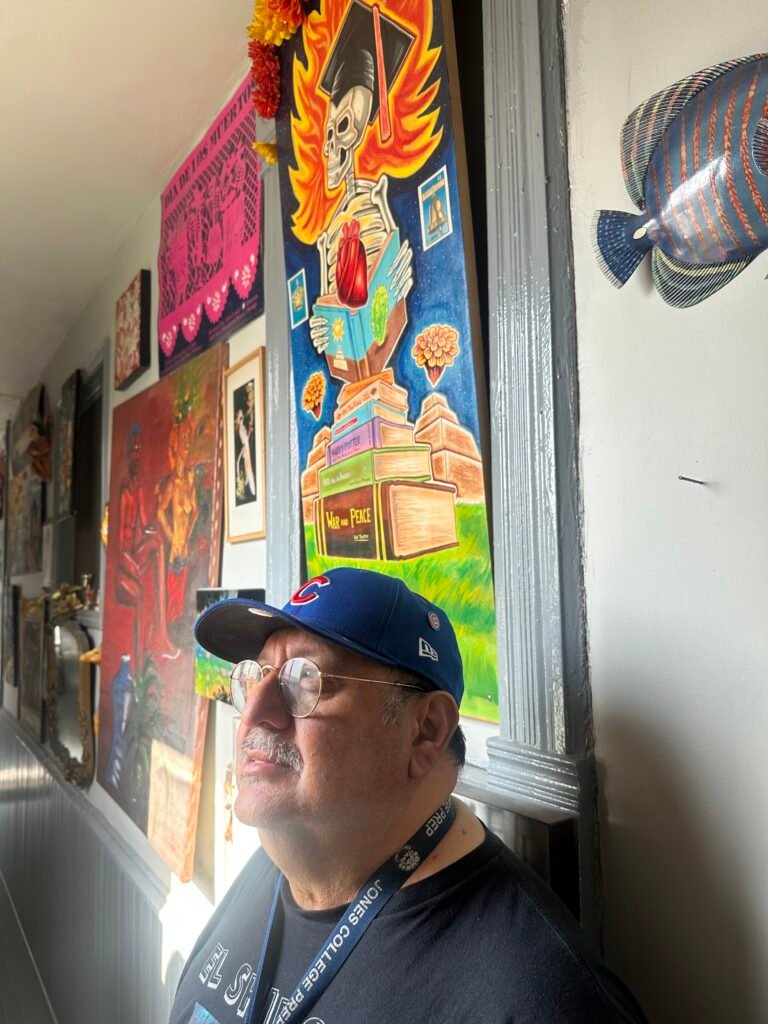
Ricky Moreno is a very good friend. (Hoekstra photo, 7/23/26)
Nelson said, “The first time I was introduced to Pete was 2003 or 2004. (Community organizer, artist) Amir Normandy knew I was doing a documentary to support (18th Street) Open Studios that was going to feature artists in the neighborhood. Amir was, ‘You gotta see Pete’s place.’ Maybe he was going to lose it. He turned it into a museum. After we did the video it turned out we knew all kinds of mutual people. Pete was a Pilsen treasure.”
A 69-year-old native of Oakland, CA., Nelson landed in Pilsen in the mid-1980s to finish his undergraduate work at the School of the Art Institute of Chicago. A good number of his classmates were from Pilsen. “These were crossover characters between Pete and myself,” he said. “I’ve been interacting in the neighborhood for four decades now and Rick (Moreno) and I didn’t meet up until a couple years ago. Yet we know all the same people.”
Nelson was knocked out stimulated by Pete’s place. “As an artist the art is secondary to the space,” he explained. “Look at these windows! Look at all the natural sunlight pouring in! It would have been a wet dream for a photographer. Pete had a lot of black and whites from some of the early marches Carlos Cortez was involved in.”
Nelson later heard the “Mayor of 18th Street” nickname for Pete, a raconteur to the root. “I heard that reference when it was said Francisco Mendoza (art teacher, muralist 1958-2012) was Mayor of Pilsen for the community,” he said. Mendoza mentored Nelson. “But when I heard that about Pete it made sense,” he said.
Once you peeled away the rough exterior, Pete was an erudite connector. “When Pete found out I was going to do a motorcycle ride through the Southwest he gave me a precise route for the best experience,” Nelson said. “People were razzing him, ‘You’ve never been on a motorcycle.’ But Pete had a lot of stories in his journey.”
He understood the feeling of being free.
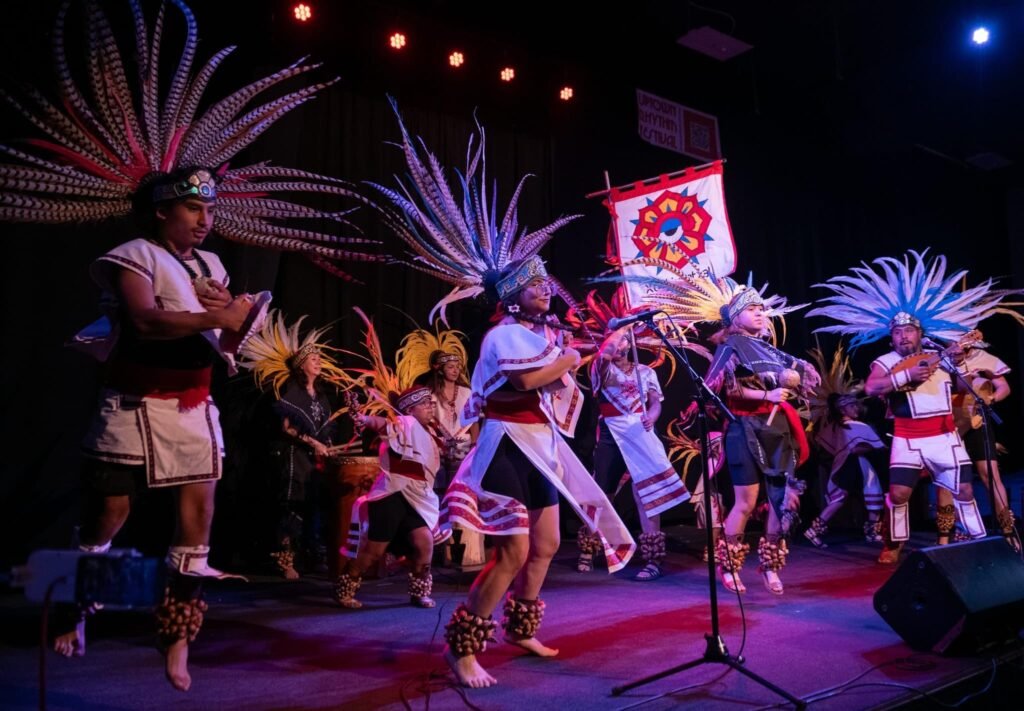
Chicago Aztec dance group Xochtil-Queztal will lead Pete’s final journey on this plane. (Provided)
Nelson’s 2011 trip on a Honda VTX 1300 went across I-80 through Iowa and Nebraska, and I-76 to Denver Colorado. “Went vertical down past Santa Fe, took the curve down the mountain from Albuquerque straight into Arizona,” Nelson said. “I had a park ranger gig four times. It was through a program called Teacher Ranger Teacher, where they hired teachers during the summer.”
Nelson worked the Petrified Forest in Arizona, along the Missouri River in Yankton, S.D. and at the Theodore Roosevelt National Park in Medora, N.D. He added, “And over the years Pete and I hooked up in his favorite bars like the Matchbox. I went to one of his birthday parties at the Penny Whistle (on South Blue Island) and he was bustin’ chops with all his childhood friends.”
Pete and Ricky also migrated north to the tavern Weeds where childhood friend Sergio Mayora was tending bar and pouring complimentary shots of tequila. They also discovered the Hideout, a bar influenced by Weeds. Artie said, “The group we grew up with were the Cullerton Boys. We played basketball and floor hockey in park district leagues. Sergio ran with the Morgan Deuces. Sergio’s uncle owned that place, and Sergio started doing things there like the artwork and poetry. That became our hangout.”
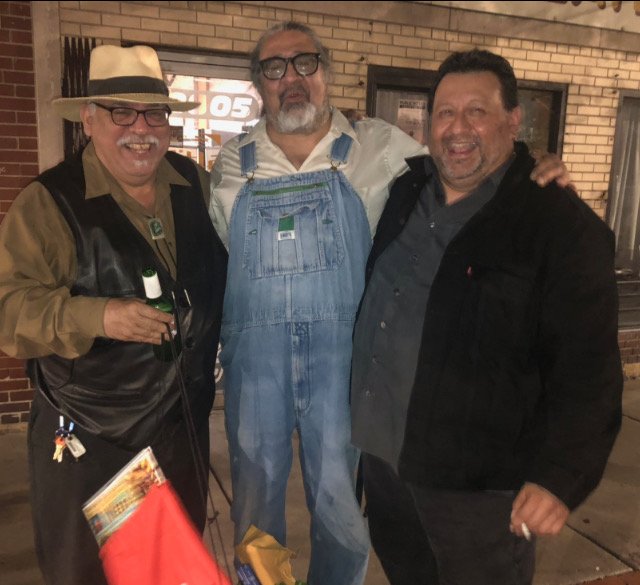
Pete (L), Sergio Mayora (C), Rick Moreno (Provided)
Gustavo Sanchez is the soft-spoken founder of the Citlalin gallery and theater. He remembered Pete’s generosity. “About 20 years ago we took the bus to a party on the north side,” Sanchez said last week. “It was a cold night. A guy was mugged and they took his jacket. A Latino guy. He was freezing on the bus. He asked for some change. Pete took off his long beautiful black coat and put it around him–’Cover up, take care of yourself.’ I asked him why he gave his coat away. He said, ‘He needs it more than I do.’ That was Pete. Very human. He was supportive of this place. He helped build the stage. He came here to paint the walls. The reason Pete had so much art is because he was always helping out artists.”
Artie didn’t seem too overwhelmed during my visit to Pete’s place. He smoked an Arturo Fuentes Cubanito and wisecracked like his brother. When I kindly said he sounded like Pete he shot back, “That’s an insult.” Artie took a puff from his cigar and continued, “I have no idea how he moved all this. One shoe at a time. He was very industrious. If he had his mind set on doing something, he would do it. He did have some friends with trucks.” Pete’s landlord wants everything cleared out by Aug. 1. Artie said, “I told him good luck with that and started laughing.”
Pete never had a grounded plan, so the future of his Chicago collection is up in the air. He had no will. He lived day to day. Ideas floating around include a museum diorama or a window homage at the Jumping Bean. His brother said, “I have nowhere to put this artwork. There’s thousands of pieces. Pete viewed this stuff in his own way. Everything Pete had its own story. It is like a catalog of fond memories. I would donate a majority of this to Gustavo and maybe we make a little section called The Pete Rodriguez Gallery. We’ve already donated about 40 pieces.”
Pete’s desire for the real corners of Chicago made me think about the White House’s Fourth of July critique of the Smithsonian Institution’s National Museum of American History by saying that it promoted “extreme ideological activism.” That’s what Pete’s places were all about. They were big, passionate, and resilient.
A few days after Pete passed the Organization of American Historians responded, in part, that the administration was attempting to “erase the conflict, struggle and diversity–the complexity—that have always defined the American experience.”
Pete Rodriguez was a conduit for this experience. The six-packs of beer, braggadocio and wayfaring characters were simply magnets for ideas and inspirations that will carry on. They will move forward through the night into a new morning.
That is his lasting power.
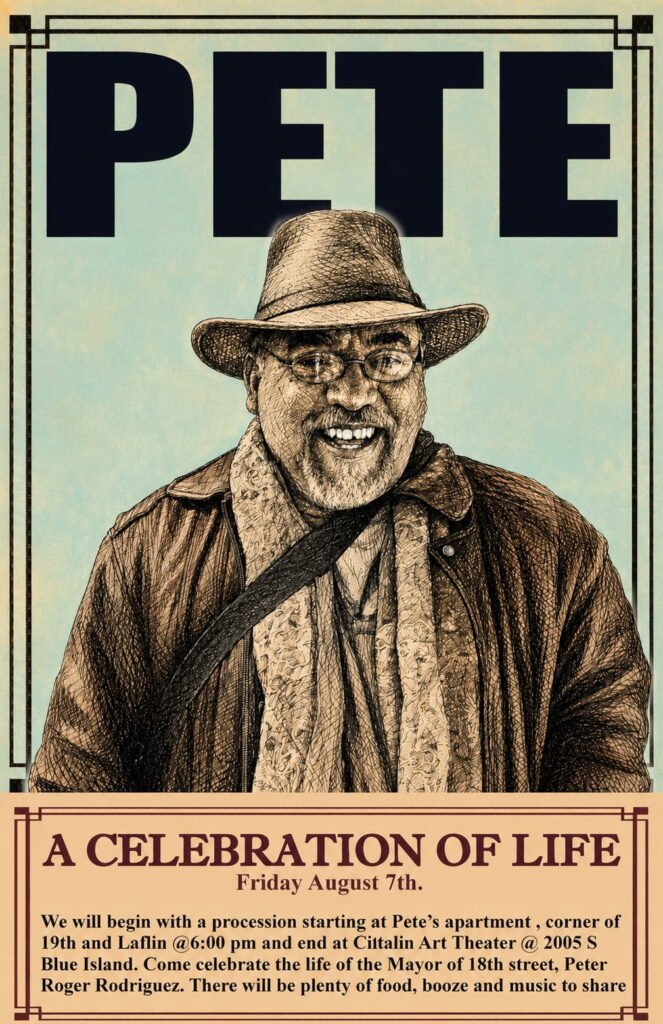
Roberto Valadez memorial poster
A GoFundMe has been established in Pete’s memory.


Hi Dave, My name is David Aguirre a long time friend of Pete, He and I traveled to many places together, including Tennessee, Mississippi, Luisiana, Texas, once he and I drove around the entire Lake Michigan in my old Volvo wagon. He shared many a stories, music and art. I live in Vermont now and would visit Pete every time I had the chance when in Chicago. I took the top photo of Pete in your wonderful article. I also have a great video interview from a year ago with Pete going through his place on 19th. let me know if you need it for any further documentation. Unfortunately, I’ll be in Europe and will not be able to attend his celebration of life.Cheers to Pete!
Thanks David, I can fix that credit…photo was given to me. Love these memories, please consider sharing more, Dave